Imagine an electrician replacing a broken fan wire. He goes to the shop and buys two connectors that look the same. Back at the site, he finds that both have pins sticking out and neither can plug into the other. He needed one male and one female connector. This small mistake happens often, and it is the reason a male female connector pair is worth understanding before you buy.
What Is a Male Female Connector?
A matching pair
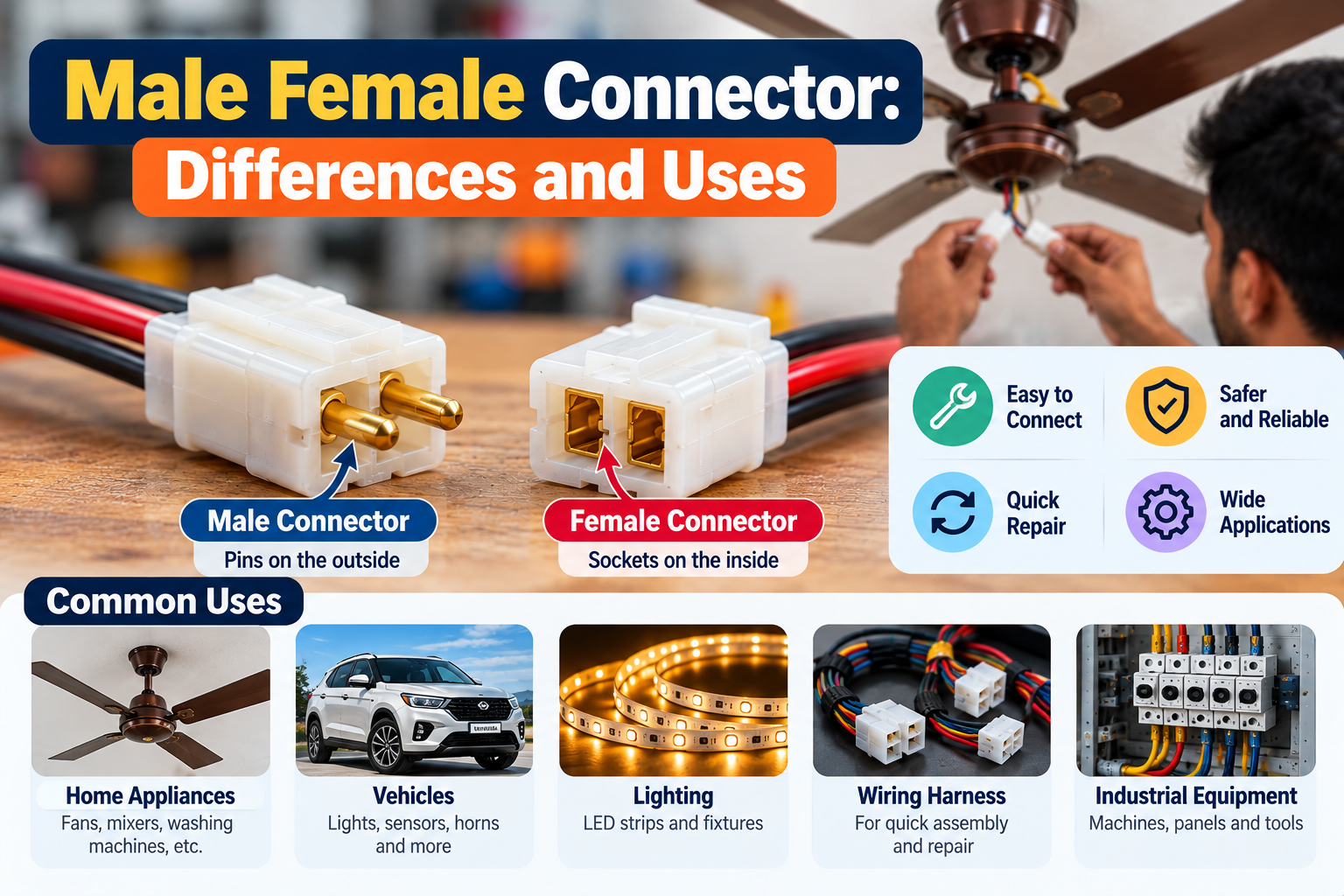
A male female connector is a pair of parts that plug into each other. One half carries pins and the other half has sockets that receive them. Together they make a firm electrical joint that you can open and close again.
Why it is used
It lets you join or separate wires without cutting, twisting or soldering each time. This makes repair, testing and assembly much faster.
What Is a Male Connector?
Pins on the outside
A male connector has one or more metal pins or blades that stick out. It is the part that goes into the other half.
Everyday example
The plug on a mobile charger cable is a male connector. Its pins go into a wall socket.
What Is a Female Connector?
Sockets on the inside
A female connector has holes or slots that receive the pins. The metal contacts are placed inside the housing.
Everyday example
A wall socket is a female connector. It is safer because the live contacts are kept inside.
Male vs Female Connector
Quick comparison
Point
Male connector
Female connector
Contact shape
Pins or blades
Sockets or slots
Role
Goes into the other half
Receives the other half
Exposed metal
Usually visible
Usually inside the housing
Common side
Often the load or device side
Often the power source side
Safety
More exposed
Better protected
Which side carries power
For safety, the side connected to the power source is usually the female one, because its contacts are covered. This is a common practice, not a fixed rule, so check the design of your product.
Common Types
Wire-to-wire connectors
These join one wire to another. They are used to extend cables or to make a detachable joint in the middle of a wire run.
Wire-to-board connectors
These connect a wire to a circuit board. They are found inside appliances, control panels and electronic devices.
Crimp terminals
Many connectors use small metal terminals, such as male blade terminals and female receptacle terminals. They are crimped onto the wire and then slipped into a plastic housing.
Pin connectors by count
A 2 pin connector carries a simple two-wire circuit. 3 pin, 4 pin and larger versions carry more wires. The pin count depends on how many circuits you need.
Common Uses
Home appliances
Fans, mixers, washing machines and air conditioners use male female connectors inside to join motors, switches and control boards.
Vehicles
Lights, sensors and horns in cars and bikes connect through sealed connectors that can handle vibration and moisture.
Lighting
LED strips and fixtures often use a simple 2 pin connector to join strips or connect them to a driver.
Wiring harness
A wiring harness uses many male and female connectors so that large assemblies can be fitted and removed in sections.
Industrial equipment
Machines, panels and tools use heavier connectors for power and signal lines, so a faulty part can be changed quickly.
Why They Come in Pairs
Easy to fit and remove
A pair makes assembly and repair simple. You can change a faulty part by unplugging it.
Correct fit every time
Most connectors have a shape or key that allows only one way of plugging in. This stops wrong connections.
Less risk of short circuit
Housings cover the contacts, which keeps them from touching other metal parts.
How to Choose the Right Pair
Check the pin count
Match the number of pins to the number of wires you need to join.
Check current and voltage rating
A connector must be rated for the current it will carry. An undersized one can overheat.
Match the wire size
Terminals are made for a range of wire sizes. Use the right one so the crimp holds firmly.
Think about the place of use
For outdoor or damp places, use sealed connectors. For moving parts, choose ones with a locking clip.
Buy matching parts
Use the male and female halves made for each other. Mixing different series can cause a loose fit.
Safe Handling Tips
Switch off first
Turn off the power before you connect or disconnect anything.
Do not pull on the wire
Hold the connector body when you separate the halves.
Check the lock
Push until you hear or feel the clip lock. A half-fitted connector can heat up.
Look for damage
Replace connectors that show burn marks, cracks or loose pins.
Conclusion
A male connector has pins and a female connector has sockets. Together they make a joint that is easy to fit, easy to remove and safe when chosen correctly. Count the pins, check the rating and match the wire size, and you will avoid most common mistakes.
If you need connectors for a repair, a product or a wiring harness, you can contact HS Electronics. Share your wire size, pin count and use, and the team can help you pick a suitable pair.
FAQ
1. How do I tell a male connector from a female connector?
A male connector has pins or blades that stick out. A female connector has holes or slots that receive them.
2. Is a plug male or female?
A plug is usually male because its pins go into a socket. The socket is usually female.
3. Why is the power side usually female?
Its contacts are covered by the housing, which lowers the risk of touching a live part.
4. Can I join two male connectors together?
No. They do not fit into each other. You need one male and one female half, or a joiner made for that purpose.
5. What is a 2 pin connector?
It is a connector with two contact points, used for simple two-wire circuits such as LED lights, small fans and low-power devices.
6. Do male and female connectors from different brands fit?
Sometimes, but not always. Parts from the same series are made to match, so they are the safest choice.
7. What happens if I use a connector with a lower rating?
It can heat up, wear out fast or fail. Always pick a connector rated for your current and voltage.
8. Can these connectors be used outdoors?
Only if they are sealed and rated for outdoor use. Standard indoor connectors can corrode when exposed to water.