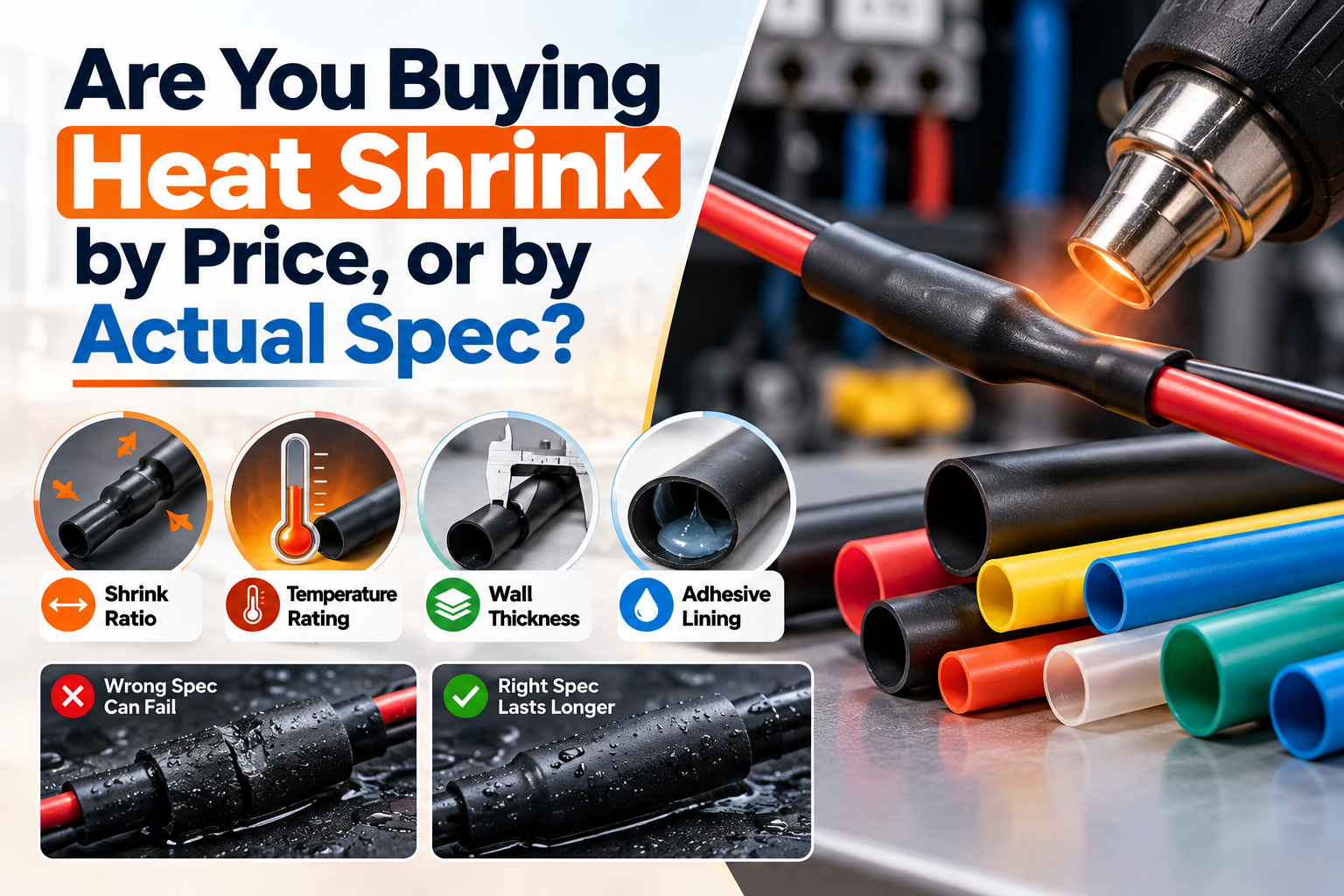
Here’s a question worth asking honestly: when you’re ordering heat shrink tube for your next project, what’s actually driving the decision, the price per metre, or the actual specification needed for your application? For something that looks like such a simple, commodity item, heat shrink tubing varies more than most buyers realise, and choosing purely on price can leave you with something technically unsuited for the job it’s actually meant to do.
Why Heat Shrink Feels Like a Commodity Item
It’s easy to see why price becomes the default deciding factor. Heat shrink looks simple, a tube that shrinks when heated, how different can one option really be from another? This perception leads a lot of buyers to treat it almost like a bulk commodity, grabbing whatever’s cheapest, assuming any heat shrink does the same basic job.
In reality, heat shrink tubing varies significantly in shrink ratio, temperature rating, wall thickness, and whether it includes an adhesive lining or not. These differences aren’t cosmetic, they directly affect whether the tubing actually does what you need it to do in your specific application.
What Actually Varies Between Heat Shrink Products
Shrink Ratio
This determines how much the tubing can shrink down from its original diameter. A lower shrink ratio limits how much size variation it can accommodate, while a higher ratio offers more flexibility for covering connections of varying sizes. Cheaper products often come with a lower, less flexible ratio.
Temperature Rating
Heat shrink used near engine components, power electronics, or anywhere generating real heat needs a genuinely higher temperature rating than tubing used for simple, low-heat indoor wiring. A product rated for lower temperatures can degrade, crack, or fail if used somewhere hotter than it was designed for.
Wall Thickness
Thin-wall heat shrink is lighter and more flexible, suited to space-constrained applications. Thick-wall versions offer more mechanical protection and insulation, better suited to harsher environments or where physical protection matters as much as insulation.
Adhesive Lining
This is one of the biggest, and most commonly overlooked, differences. Adhesive-lined heat shrink creates a genuine moisture seal once heated properly, the lining flows slightly and bonds to the wire and surrounding insulation. Standard heat shrink without this lining simply wraps tightly, it doesn’t actually seal against water or moisture ingress.
Why Choosing Purely on Price Can Backfire
You Might Be Missing Genuine Weatherproofing
If your application involves any outdoor exposure, an air conditioning wire connection, external lighting, anything facing rain or humidity, standard heat shrink without adhesive lining simply won’t provide the moisture seal you actually need, regardless of how neat it looks once applied.
You Might Be Risking Heat-Related Failure
Using a lower temperature-rated product in a genuinely hot environment, near engine components, power electronics, anywhere generating sustained heat, risks the insulation cracking or degrading faster than expected, potentially exposing the wire underneath.
You Might Be Paying for More Than You Need
The opposite mistake happens too. Using premium, adhesive-lined, high-temperature heat shrink for a simple, indoor, low-heat application wastes money on specifications your use case doesn’t actually require.
Questions to Ask Before You Buy
Will This Connection Face Any Outdoor or Moisture Exposure?
If yes, adhesive-lined heat shrink is worth the extra cost. Standard tubing simply doesn’t provide a genuine seal, no matter how tightly it shrinks visually.
What Temperature Range Will This Actually Experience?
Check the realistic operating temperature of your application, not just room temperature, but what it’ll experience under load, near heat-generating components, or in direct sunlight if outdoors.
Does This Connection Need Mechanical Protection, or Just Insulation?
If the wire is exposed to physical abrasion, movement, or potential impact, thicker-wall heat shrink offers more protection than a thin, purely insulating option.
What’s the Actual Shrink Ratio I Need?
If you’re covering connections of varying sizes, a higher shrink ratio gives you more flexibility to use one product across a range of applications, rather than needing multiple different diameters on hand.
How to Actually Compare Options Properly
Check the Specification Sheet, Not Just the Price Tag
A genuine spec sheet will list shrink ratio, temperature rating, and whether adhesive lining is included. If a supplier can’t provide this, that’s worth noting as a gap in transparency.
Ask Directly Whether It’s Adhesive-Lined
Don’t assume, ask explicitly. This single detail makes the biggest practical difference for any application involving moisture or outdoor exposure.
Compare Like-for-Like, Not Just Total Cost
A cheaper product with a lower temperature rating and no adhesive lining isn’t actually a fair comparison against a pricier, properly specified option, they’re solving different problems, even if they look similar on the shelf.
Consider the Cost of Failure, Not Just the Purchase Price
A slightly more expensive, properly rated heat shrink is almost always cheaper in the long run than dealing with a failed connection, water damage, or a safety issue caused by using an undersized product to save a small amount upfront.
A Simple Comparison
Factor Budget Heat Shrink Properly Specified Heat Shrink
Moisture sealing Usually none Adhesive-lined options available
Temperature tolerance Often lower Matched to your actual application
Shrink flexibility Lower ratio Higher ratio, more versatile
Long-term reliability Uncertain Consistent, predictable performance
When Price-First Buying Genuinely Makes Sense
To be fair, not every application needs premium specification. A simple, indoor, low-heat, permanently dry connection may genuinely be fine with standard, lower-cost heat shrink. The point isn’t that cheaper is always wrong, it’s that the decision should follow from your actual application’s needs, not just default to whatever costs the least without checking if it’s actually suitable.
A Simple Self-Check
Does this connection face any outdoor or moisture exposure?
Do you know the actual temperature range this will experience?
Have you checked the specification sheet, or just compared prices?
Have you asked explicitly whether the product is adhesive-lined?
Are you comparing genuinely similar products, or just picking the cheapest option available?
If you’re unsure about more than one or two of these, it’s worth pausing to check the actual specification before placing your order.
Final Thoughts
Heat shrink tubing looks simple enough to treat as an interchangeable commodity, but shrink ratio, temperature rating, wall thickness, and adhesive lining genuinely differ between products, and those differences directly affect whether it’ll actually do the job you need. Buying purely on price, without checking these specifics, risks ending up with something that looks finished but doesn’t perform the way your application actually requires.
If you want help choosing heat shrink that’s genuinely matched to your application, rather than just the cheapest option available, reach out to HS Electronics. Share your environment, temperature range and moisture exposure details, and the team can guide you toward a heat shrink tube that’s properly specified for what you’re actually building.