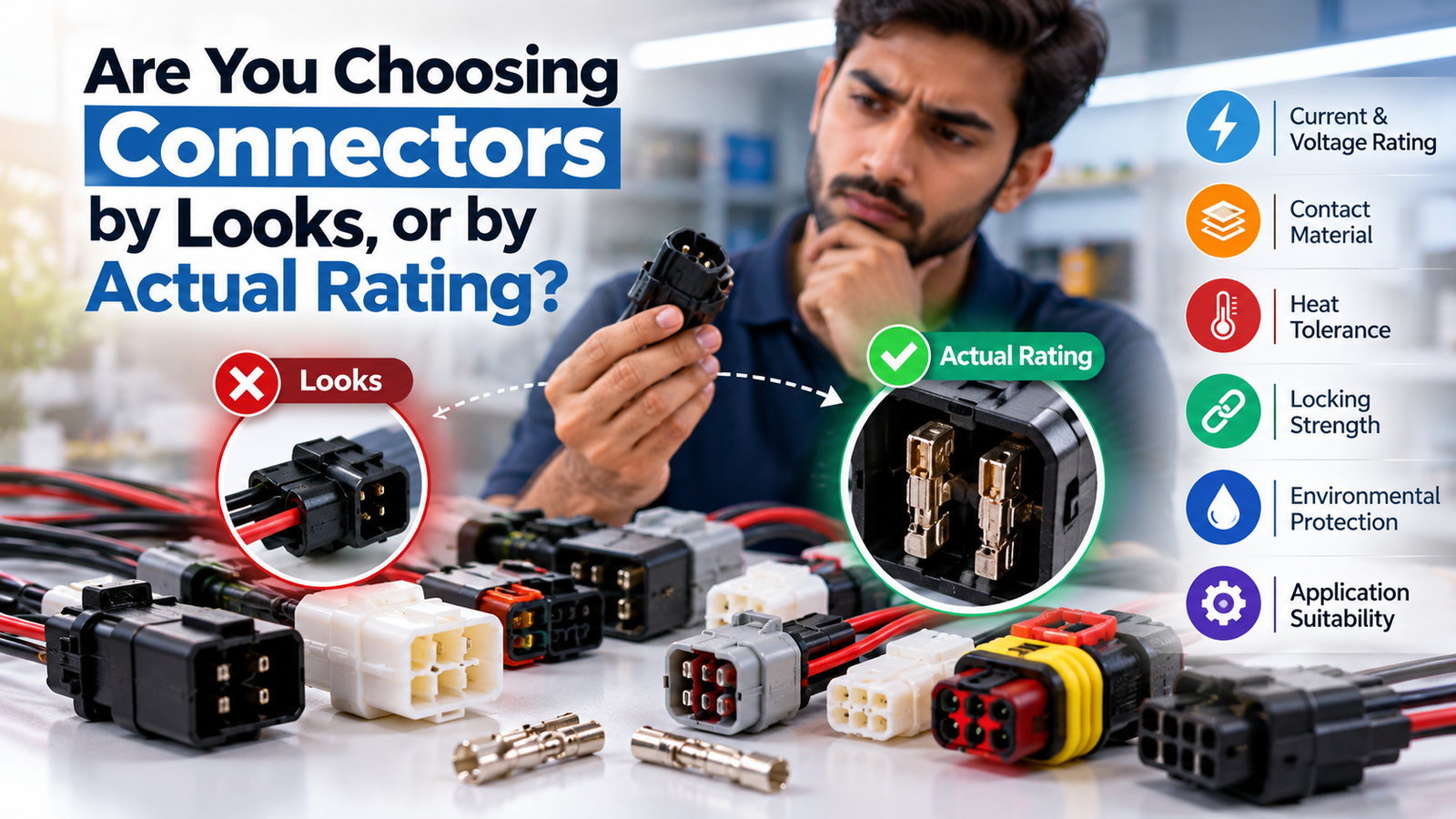
Here’s a question worth asking honestly, next time you’re reaching for a connector: are you picking it because it’s genuinely rated for the job, or because it looks about the right size, the right shape, roughly similar to what you’ve used before? Connectors are deceptively uniform-looking. Two that appear nearly identical can be rated for very different current loads, and that difference isn’t something you can judge by eye.
This is one of the most common, and most avoidable, mistakes in wiring work. Let’s look at why it happens, and how to actually check what you’re working with.
Why Visual Matching Feels So Natural
When you need a connector, the fastest path is usually to grab something that looks right, same pin count, similar size, familiar shape, and assume it’ll work. This isn’t carelessness exactly, it’s just how most people naturally approach a quick, practical task, especially under time pressure.
The problem is that wiring connectors can look nearly identical while being built for completely different purposes. A connector designed for low-current signal wiring can look almost indistinguishable from one rated for a genuinely heavy power load, same housing shape, same pin arrangement, very different internal contact quality and current capacity.
What Actually Determines a Connector’s Rating
Contact Material and Plating
The metal used for the actual contact points, and how it’s plated, directly affects how much current it can safely carry and how well it resists corrosion over time. A connector with thin, low-quality plating might look fine on day one but degrade quickly under real use.
Contact Size and Surface Area
Larger, thicker contacts generally handle more current safely than smaller, thinner ones, even within connectors that look superficially similar from the outside. This internal detail isn’t something you can judge just by looking at the housing.
Housing Material
The plastic or material the connector is built from affects its heat tolerance and durability. A power connector carrying real current generates heat, and a housing not built to handle that can degrade, warp, or become a safety risk over time.
Locking Mechanism Strength
Whether it’s a male female connector pair or a multi-pin design, how securely the two halves lock together affects whether the connection stays solid under vibration or movement, something that matters enormously for automotive or industrial applications.
Why Choosing by Looks Alone Is Risky
You Might Be Undersizing for Your Actual Load
If you select a connector based on general appearance rather than confirmed current rating, you risk using something genuinely undersized for your application. This doesn’t usually fail immediately, it fails gradually, through heat build-up, degraded insulation, and eventually, a connection that loosens or burns out.
You Might Be Overpaying for Unnecessary Capacity
The opposite mistake happens too. Choosing a heavy-duty, over-rated connector for a light, low-current application wastes money unnecessarily, when a simpler, cheaper 2 pin connector would have done the job perfectly well.
You Lose the Ability to Troubleshoot Properly
If you don’t know the actual rating of what’s installed, diagnosing a future problem becomes genuinely harder. You’re left guessing whether a fault is due to an undersized component or something else entirely, rather than confidently ruling components in or out.
Questions to Ask Before You Choose a Connector
What’s the Actual Current and Voltage of This Application?
This is the non-negotiable starting point. Check your equipment’s specification sheet or rating plate for the real numbers, not an estimate, not “it’s similar to the last one.”
Is This Connector Explicitly Rated for That Load?
Ask directly, or check the manufacturer’s documentation, rather than assuming based on size or shape. A genuine specification sheet will state the rated current and voltage clearly.
Will This Connection Face Vibration or Movement?
If you’re working with anything like automotive wiring, or equipment that experiences regular movement, standard connectors rated for stationary use may not hold up. You need something specifically rated for vibration resistance.
How Often Will It Be Connected and Disconnected?
A connector meant for occasional maintenance access needs different durability than one designed for a permanent, one-time installation. This affects both the mechanical design and the expected lifespan.
Is the Environment Indoor, Outdoor, or Exposed to Moisture?
A connector that’s fine in a dry, indoor panel may not hold up outdoors or in a humid environment. Weatherproofing and sealing ratings matter here, and they’re not visible just by looking at the housing.
How to Actually Verify a Connector’s Rating
Check the Manufacturer’s Specification Sheet
This is the most reliable source, current rating, voltage rating, temperature range, and often vibration or environmental ratings too, all documented clearly rather than assumed.
Ask Your Supplier Directly
A good supplier of electrical wiring connectors should be able to tell you exactly what rating a specific connector carries, and help you match it to your actual application rather than just selling whatever’s in stock.
Don’t Rely on “It Looks Like the One We Used Before”
Even connectors from different batches or suppliers that appear visually similar can carry different internal specifications. If the application matters, verify fresh each time rather than assuming continuity.
Test Under Real Conditions Where Possible
For critical applications, a simple test, checking for warmth after sustained use, confirming the connection stays secure under movement, can reveal problems before they become serious failures.
A Quick Comparison: Looks vs Rating
What You See
What It Doesn’t Tell You
Pin count and housing shape
Actual current capacity
General size
Contact material quality
Colour or branding
Vibration resistance rating
Similarity to a previous part
Whether this specific batch matches that spec
A Simple Self-Check
Do you know the actual current and voltage rating required for this application?
Have you confirmed the connector’s specification, rather than assuming based on appearance?
Does this application involve vibration, movement, or outdoor exposure?
Have you verified this with the manufacturer’s documentation or a knowledgeable supplier?
Are you choosing based on a genuine match, or just familiarity with how it looks?
If you’re unsure about more than one or two of these, it’s worth pausing and actually checking the specification before installing anything.
Final Thoughts
Connectors are one of those components where a visual match feels reassuring, but genuinely tells you very little about whether it’s actually right for your application. The real answer lies in the rating, current capacity, voltage tolerance, vibration resistance, not the shape or size you can see from the outside.
If you want help choosing connectors that are genuinely matched to your application, rather than just visually similar to what you’ve used before, reach out to HS Electronics. Share your voltage, current and environmental requirements, and the team can guide you toward a pin connector or female connector option that’s properly rated for what you’re actually building, not just close enough.