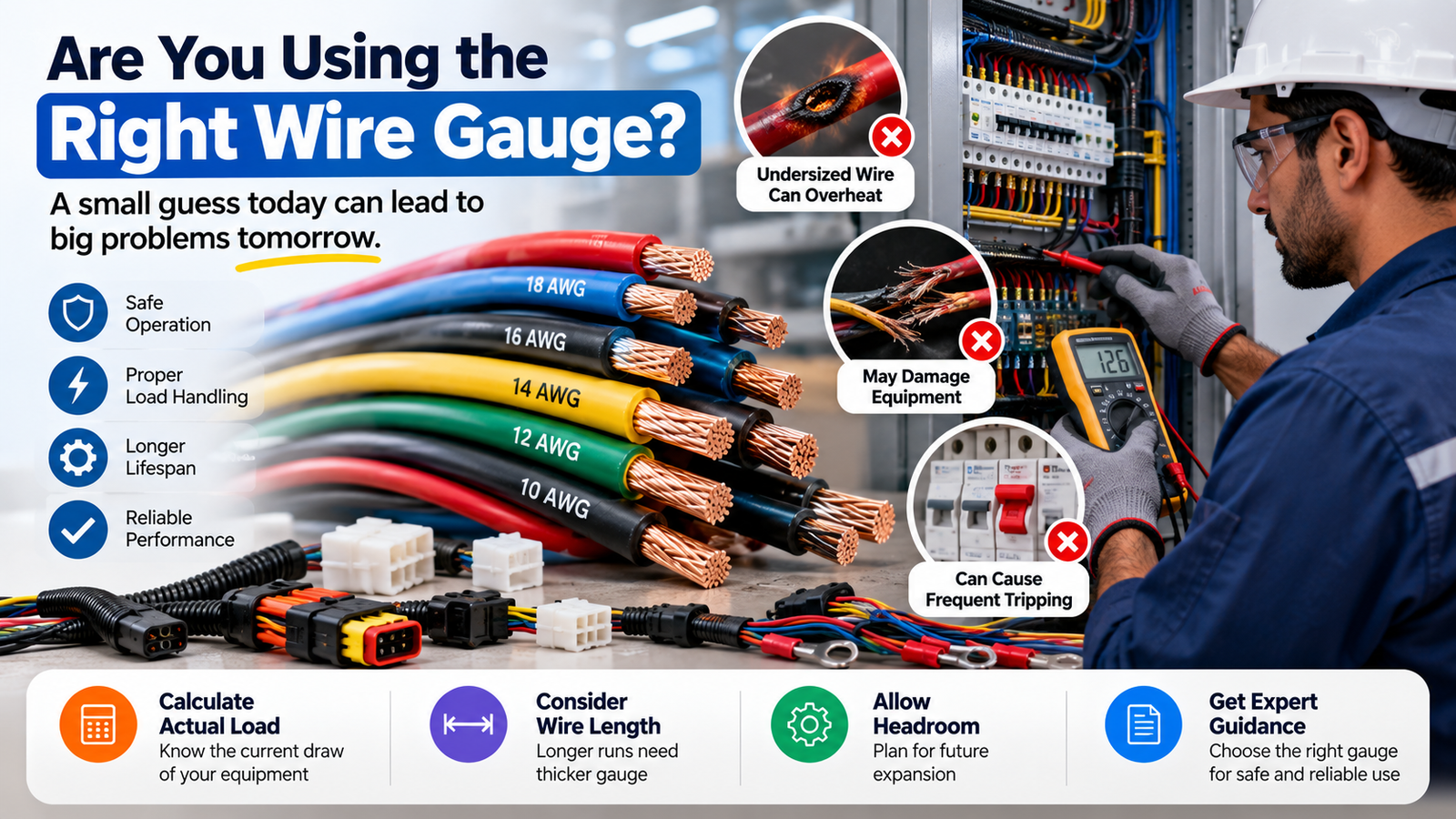
Here’s a question worth asking honestly: did you choose the wire gauge in your current setup based on an actual calculation of your load, or because it’s roughly what’s always been used, what the previous installer happened to have on hand, or what simply “looked about right” for the job?
This matters more than it might seem. Wire gauge isn’t a detail you can eyeball confidently, two wires can look nearly identical in thickness while being rated for very different current loads. Get it wrong, even slightly, and you’re not looking at an obvious, immediate failure, you’re looking at a slow, quiet problem that builds up gradually until it eventually causes one.
Why This Gets Guessed More Often Than You’d Think
Wire gauge selection sounds like it should be straightforward, match the gauge to the load, done. But in practice, a lot of wiring and harness decisions happen under time pressure, during a repair, a quick expansion, a last-minute addition of new equipment. In those moments, it’s tempting to just use whatever wire electrical wire is already on hand, or match it loosely to something similar that seemed to work fine elsewhere.
This habit rarely causes an immediate problem. Undersized wire doesn’t usually fail the first time it’s used, it fails gradually, as repeated heat cycling slowly degrades the insulation, or as a connection point weakens under sustained, excessive current. By the time something actually goes wrong, it’s easy to forget that the original gauge selection was ever a guess in the first place.
Questions Worth Asking About Your Current Wiring
Do You Know the Actual Current Draw of What You’re Powering?
This is the starting point, and a surprising number of people skip it entirely. Before you can know if your electrical wiring gauge is correct, you need to know the actual amperage your equipment draws, not a rough estimate, the real number, usually available on the equipment’s rating plate or specification sheet.
Was the Gauge Chosen for This Specific Load, or Copied From Somewhere Else?
Think back honestly. Was your current wiring sized specifically for this application, or was it based on “this is what we used for the last machine” or “this is what the shop had available”? Different equipment, even equipment that seems similar, can have genuinely different current requirements, especially when comparing something like an automotive wiring harness against a fixed indoor installation.
Have You Accounted for Wire Run Length?
This is a factor people often miss entirely. Longer wire runs experience more voltage drop, which means a gauge that’s technically adequate for a short run might actually be undersized once you factor in a longer distance between the power source and the equipment. If your setup involves any meaningfully long runs, this needs to be factored in, not assumed away.
Does the Wire Ever Feel Warm During Normal Operation?
This is one of the clearest physical warning signs. Properly sized wire, under normal load, shouldn’t feel noticeably warm to the touch during regular operation. If you’ve checked and found warmth, especially consistent warmth rather than a brief spike, that’s a real signal the gauge may be undersized for what it’s actually carrying.
Have You Added Equipment Without Rechecking the Original Wiring?
This is extremely common, and genuinely understandable. A business adds a new machine, plugs it into existing wiring that was sized for a different, often lighter, original load, and never circles back to check whether the combined draw still falls within safe limits.
Signs Your Wire Gauge Might Be Undersized
The wire or nearby outlets feel warm during normal operation, not just occasionally, but consistently
You’ve added equipment or extended usage hours since the wiring was originally sized
You don’t actually know the current rating of your existing wire, just that “it’s been fine so far”
Circuit breakers trip more often than they used to, especially when certain equipment runs
You have any notably long wire runs that were never specifically checked for voltage drop
None of these guarantee a problem exists right now, but together, they’re a reasonable signal that it’s worth checking properly rather than continuing to assume everything’s fine.
What Getting the Gauge Right Actually Involves
Know Your Actual Amperage
Check your equipment’s rating plate or specification sheet for the actual current draw, not an estimate. This is the non-negotiable starting point for any proper gauge calculation, whether you’re working with a simple wiring kit or a more complex industrial setup.
Factor in Continuous vs Intermittent Load
Equipment that runs continuously for long stretches needs more conservative gauge sizing than something used briefly and occasionally, since sustained current generates more cumulative heat over time.
Account for Wire Run Length
Longer runs need thicker gauge wire to compensate for voltage drop, even if the current draw itself stays the same. A gauge that’s fine for a short run can genuinely be inadequate for a longer one carrying the same load.
Build in Reasonable Headroom
Sizing wire exactly to today’s minimum requirement leaves no margin for future growth, or for the natural variation in how equipment actually draws current under different conditions. A bit of headroom now avoids a repeat problem later.
Get It Checked by Someone Who Actually Calculates, Rather Than Estimates
A properly done gauge calculation accounts for all of the above together, current, length, continuous use, headroom, rather than relying on a rough visual match to something that “seems similar.”
Where Gauge Mistakes Commonly Show Up
Undersized wire doesn’t only affect large industrial setups. It shows up in surprisingly everyday places too, ac wiring installations, wire for home electrical circuits, even basic 2 pin connector and male female connector assemblies used for smaller equipment. Anywhere current flows through a wire, the gauge needs to genuinely match the load, there’s no application small enough to skip this check safely.
Why This Matters Especially for Growing Noida Businesses
As businesses in Noida scale up, add machines, extend working hours, and increase overall power demand, it’s common for wiring decisions to happen incrementally, a bit added here, a connection extended there, without anyone stepping back to properly recalculate against the combined load. This kind of gradual, piecemeal wiring growth is exactly where undersized gauge problems tend to quietly build up over time.
What to Do If You’re Unsure
Get the Actual Numbers First
Before anything else, gather the real current ratings for your key equipment, rather than relying on memory or rough estimates.
Ask for a Proper Calculation, Not a Visual Match
When sourcing or reviewing wiring with an electronics manufacturer or supplier, ask specifically how they’re calculating the required gauge, current, length, continuous use, rather than accepting “this should be fine” as an answer.
Check for Warmth and Other Physical Signs
A simple, periodic check, feeling for warmth at outlets and along accessible wire runs during normal operation, can catch an undersized gauge problem before it becomes a serious failure.
Don’t Just Patch, Recalculate for the Full Picture
If you’ve added equipment over time, it’s worth recalculating your wiring needs for the combined, current total load, not just adding one more connection onto an already-stretched setup.
A Simple Self-Check
Do you know the actual current draw of your key equipment, or just a rough guess?
Was your current gauge chosen specifically for this load, or copied from elsewhere?
Have you accounted for wire run length in your calculation?
Does any part of your wiring feel warm during normal operation?
Have you added equipment since the original wiring was sized, without rechecking it?
If you’re unsure about more than one or two of these, it’s genuinely worth getting a proper check rather than continuing to rely on assumption.
Final Thoughts
Wire gauge isn’t something you can reliably judge by eye, and getting it even slightly wrong doesn’t usually cause an immediate, obvious failure, it causes a slow, quiet problem that builds up until it eventually does. For any business relying on wiring connectors and wire sized through habit or rough matching rather than actual calculation, it’s worth taking the time to check properly.
If you want an honest assessment of whether your current wire gauge actually matches your real load, reach out to HS Electronics. As an experienced electronics manufacturer serving Noida, the team can help you work out exactly what your setup needs, whether it’s a simple power connector or a full electrical harness, rather than relying on a guess that’s been getting by so far.