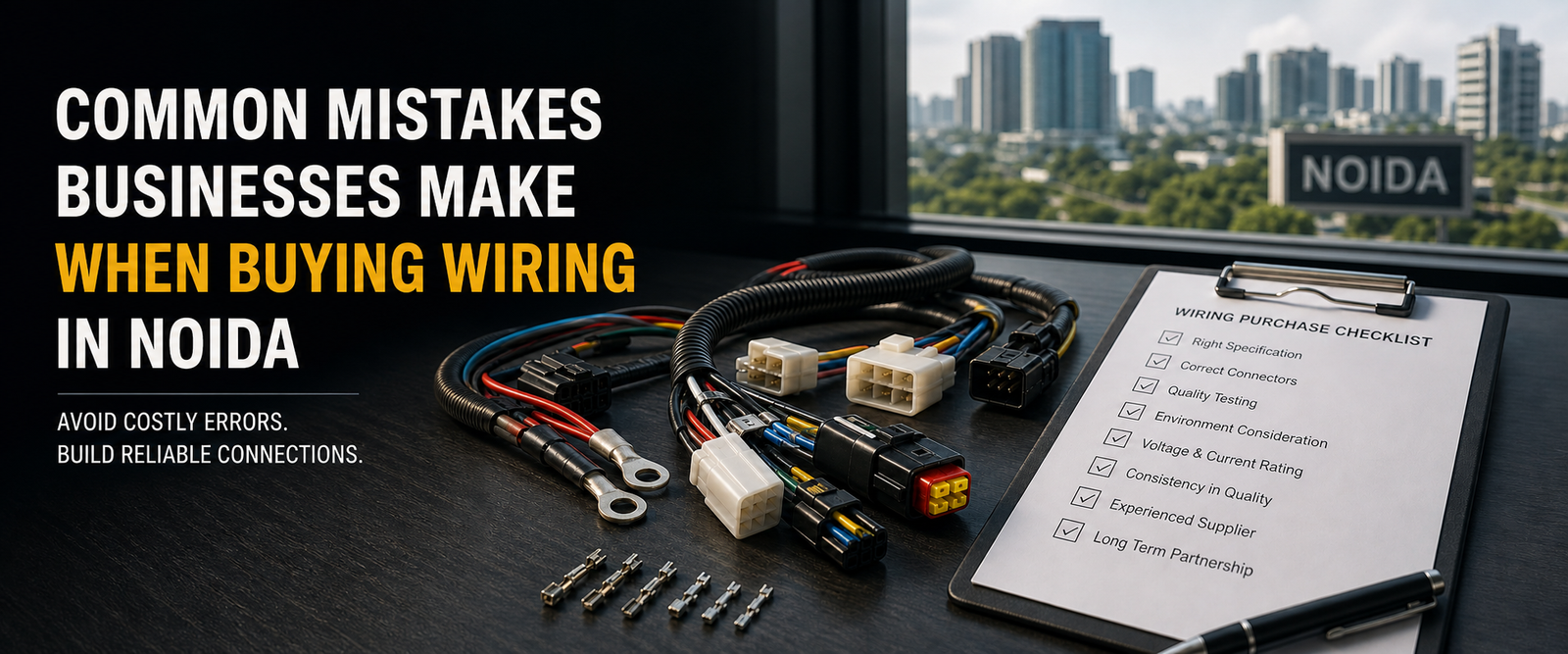
Wiring rarely gets the attention it deserves, right up until something fails. For businesses across Noida, buying wiring harness components and related electrical supplies often happens under time pressure, a product needs to ship, a machine needs repair, a deadline is close. In that rush, small but costly mistakes slip through, mistakes that quietly show up later as product failures, safety issues or wasted money.
Here are the most common ones, and how to avoid them.
Mistake 1: Choosing Price Over Specification
This is probably the most frequent mistake businesses make. A quote comes in lower than expected, and it’s tempting to just go with it. But price alone tells you very little about what you’re actually getting.
A cheaper electrical wiring component often means thinner wire gauge, lower-grade insulation, or connectors made from inferior materials. These differences aren’t always visible on the surface, but they show up later, in the form of overheating, failures under load, or connections that simply don’t last.
What to do instead: Always ask what’s included at that price, wire gauge, material grade, and whether any testing has been done. Compare specifications side by side, not just the final number.
Mistake 2: Not Sharing Complete Application Details
Many buyers approach a supplier with a vague request, “I need some wiring for my machine,” without explaining the voltage, current, environment, or how the wiring will actually be used. This leaves the supplier guessing, and guesswork rarely produces the right result.
An electronics manufacturer can only recommend the correct wire gauge, insulation type and connector style if they understand your actual application. Leaving out details like outdoor exposure, vibration, or high-temperature conditions often leads to a mismatch between what’s delivered and what’s actually needed.
What to do instead: Share as much detail as possible upfront, application type, voltage, current rating, and the physical conditions the wiring will face.
Mistake 3: Skipping the Sample Stage
Especially under time pressure, it’s tempting to place a full order directly, particularly if a supplier promises fast delivery. But skipping the sample stage means you only discover problems, loose connectors, thin wire, inconsistent quality, after the entire batch has already arrived.
What to do instead: Even for urgent orders, insist on seeing at least a small sample before committing to the full quantity, wherever time genuinely allows it.
Mistake 4: Assuming All Connectors Are Interchangeable
Connectors look similar from a distance, but wiring connectors vary significantly in pin count, current rating, and physical fit. Businesses sometimes assume a connector will work simply because it looks like the right size, only to find it doesn’t lock securely, or isn’t rated for the actual current passing through it.
What to do instead: Always confirm the exact connector type and rating required for your application, rather than relying on a visual match alone.
Mistake 5: Not Asking About Testing and Quality Checks
A finished wiring harness or cable assembly might look fine on the outside, while still having a loose crimp or a weak insulation point that isn’t visible without proper testing. Many businesses never ask whether their supplier actually tests products before dispatch, continuity checks, insulation resistance, connection strength.
What to do instead: Ask directly what quality checks are performed, and whether this applies to the full bulk order or just an initial sample.
Mistake 6: Ignoring the Environment the Wiring Will Face
A power connector or cable that works perfectly indoors might fail quickly outdoors, exposed to moisture, dust, heat or vibration. Businesses sometimes order generic, indoor-rated components for applications that actually need weatherproof or ruggedised wiring, leading to early failures that could have been avoided.
What to do instead: Be specific about where and how the wiring will be used, indoor, outdoor, vehicle-mounted, high-vibration, so the right protective rating can be factored in from the start.
Mistake 7: Underestimating Current and Voltage Requirements
Using an undersized wire electrical wire or connector for a higher current load is a dangerous mistake, and more common than it should be. It usually happens when a business reuses an old specification for a new, higher-powered product without rechecking the actual load requirements.
What to do instead: Recalculate your actual voltage and current needs for each new application, rather than assuming a previous spec will automatically work.
Mistake 8: Not Confirming Consistency Across Bulk Orders
A great sample doesn’t guarantee that every unit in a large bulk order will match it exactly. Businesses sometimes approve a sample, place a big order, and then discover quality has dropped somewhere in the middle of production, without having any system in place to catch it.
What to do instead: Ask your wiring harness manufacturers how they maintain consistency across large runs, and where possible, request a few pieces from the middle of a bulk order, not just the beginning.
Mistake 9: Working With a Supplier Who Doesn’t Understand Your Industry
Not every wiring supplier has experience across every application. A supplier skilled in home appliance wiring might not have the same depth of knowledge for automotive or industrial applications, which have very different stress, vibration and temperature demands.
What to do instead: Ask about the supplier’s experience with your specific industry or application, not just their general manufacturing capability.
Mistake 10: Treating It as a One-Time Transaction
Some businesses change suppliers frequently, chasing small price differences each time, rather than building a relationship with a reliable electrical harness partner. This constant switching often means starting from scratch each time, re-explaining requirements, re-testing samples, and losing the consistency that comes from a supplier who already understands your business.
What to do instead: Once you find a supplier who delivers consistent quality and understands your needs, it’s usually worth maintaining that relationship rather than switching purely on price.
A Quick Checklist to Avoid These Mistakes
- Compare specifications, not just price
- Share complete application details upfront
- Always test a sample before a bulk order
- Confirm exact connector type and rating, don’t assume
- Ask about testing procedures before dispatch
- Specify the real-world environment the wiring will face
- Recalculate voltage and current needs for each new application
- Check for consistency across large production runs
- Choose a supplier experienced in your specific application
- Build a long-term relationship rather than switching constantly